Air-to-Air Heat Pumps.

This heating solution is highly efficient and low carbon, providing heating in winter and cooling in summer. It can also be mounted high to maximize wall space. 

Air to Air Heat Pumps Explained

Air-to-air heat pumps work by transferring heat from the outside air to the air inside a building, which results in the temperature increase of each room.  

This warm air is then distributed throughout the building via a series of fan coil units, also known as 'blowers'.  

Although air-to-air heat pumps are sometimes called air conditioning, they can be used for heating and cooling buildings. However, it's important to note that they don't heat water delivered to the taps. Therefore, if you want hot water for showering or bathing, you must consider another way of heating it. 

Air-to-air heat pumps are not commonly used in the UK, especially for heating larger homes. Instead, most domestic heat pump installations use air-to-water systems, with Air Source Heat Pumps being the most common. This is because the external air temperature is not as high as in southern European countries, so air-to-air is not as efficient in the UK. Also, in other parts of Europe, air-to-air systems are more common, partly due to their ability to cool as well as heat, which is particularly useful in warmer climates. 

In the UK, Air-to-air heat pumps are more frequently installed in smaller properties such as park homes or flats.

How are the rooms heated? 

In the UK, wet heating systems (radiators or underfloor heating) are commonly used to keep rooms warm. Air-to-air heat pumps do not need a wet central heating system.  

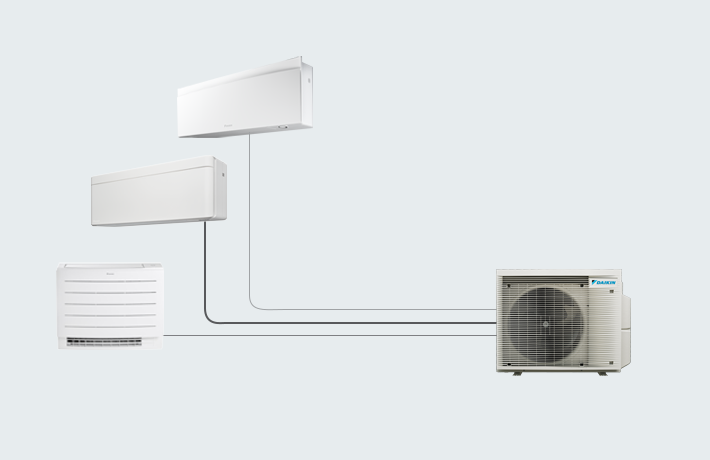
An air-to-air heat pump works by blowing warm air into the room either through a fan coil unit (Blower) or air ducting pipes. The blower is usually placed high on the wall, and the ducting system is installed hidden inside the ceiling voids.  

A single-head air-to-air heat pump has one outdoor unit and one indoor blower unit, while a multi-head air-to-air heat pump has multiple indoor blower units connected to one outdoor unit. The single-head air-to-air heat pump is suitable for small homes with just one room to heat, while the multi-head air-to-air heat pump is used for larger homes with multiple rooms.  

One good thing about air-to-air heat pumps is that they can be quick and easy to install in some types of properties and do not require any plumbing work. The multi-head air-to-air heat pump requires pipes to be installed from the outdoor unit to each indoor blower units. These pipes are usually placed around the upper edges of the room to keep them out of the way - often behind a slim plastic channel.

Deciding on how to heat your water 

Air-to-air heat pumps can be great for keeping your home warm and cosy. However, they don't heat up water for your showers, baths, or taps. So, you'll need to find a different way to heat water. There are a few different gas free options to choose from, depending on how much hot water your household needs and your budget. One option is to install a hot water cylinder with an electric immersion heater. Another option is to use electric showers or "point of use" water heaters. Point-of-use heaters can be powered by gas, LPG, or, most commonly, electricity, and they can be mounted under the sink out of sight. 

Air to Air Heat Pump considerations

When you have an air conditioning system installed, there are blowers that help circulate the air. These blowers need to be connected to the outside unit through pipes. To avoid running long pipes inside your home, the blowers are usually installed on the inside of an exterior wall close to the outside unit. If you plan to have multiple blowers, the installer will try to keep the pipe lengths as short as possible for each blower location. So, when someone comes to survey your house for installation, make sure to ask them about the possible routes the pipes will take, so that you know what to expect before they start their work. 

Ducted systems for air-to-air heat pumps are used in energy-efficient homes, like 'Passivhauses'. They work by moving air around the house through pipes hidden inside the ceiling. You can see two grills in each room, one for air to come in and one to go out. The air is warmed in a big machine, called an air handling unit, that's about the size of a boiler and is usually installed in an attic or utility room. However, if you have an older or bigger home with high heating needs, ducted systems might not work well for you since air cannot carry as much heat as a wet central heating system.


Efficiency and Benefits: 

Compared to traditional systems, Air-to-air heat pumps  offer several advantages: 

  • Energy efficiency: Air-to-air heat pumps can be highly efficient, using up to 75% less energy for cooling and 60% less for heating compared to conventional methods. This translates to significant cost savings on your energy bills. 
  • Renewable energy: Air-to-air heat pumps harness naturally occurring heat from the air, reducing reliance on fossil fuels and your carbon footprint. 
  • Dual function: One system provides both cooling and heating, eliminating the need for separate air conditioners and boilers. 
  • Space-saving: Air-to-air heat pumps require less space compared to traditional systems, as they don't need water tanks or large outdoor units. 
  • Lower maintenance: They generally require less maintenance than boilers and air conditioners. 


Considerations for UK Homes: 

While promising, Air-to-air heat pumps have some drawbacks and limitations to consider: 

  • Upfront cost: Installation can be more expensive than standard air conditioners or boilers, though government incentives like the Boiler Upgrade Scheme (BUS) can help. 
  • Cold weather performance: Efficiency can decrease in very cold temperatures (below freezing), requiring alternative heating sources in some cases. 
  • Air quality: Air-to-air heat pumps  only filter dust and large particles, not allergens or pollutants. Consider additional air purifiers if needed. 
  • Noise: Indoor units can generate some noise, though choose quieter models for sensitive areas. 
  • Home suitability: Air-to-air heat pumps  work best in well-insulated homes with open floor plans. Poor insulation can hamper their effectiveness. 
  •  

Things to Know for UK homeowners: 

  • Climate: The UK's temperate climate generally makes Air-to-air heat pumps suitable but consider supplementing for extreme cold periods. 
  • Regulations: Building regulations apply to installing new HVAC systems. Consult with a qualified installer for compliance. 
  • Grants and incentives: Utilise BUS and other programs to offset upfront costs and encourage greener options. 
  • MCS certification: Choose MCS-certified installers for high-quality work and warranty compliance. 


 What money will I save with an air-to-air heat pump? 

 If you're considering installing an air-to-air heat pump, it's important to keep in mind that the amount you'll save on your energy bill will depend on how the system is designed and operated, as well as the system you're replacing. Unfortunately, there is not much independent information available about how these systems perform in the UK, so it's difficult to predict how much money you'd save by installing one. However, your installer should be able to give you some general guidance on what to expect in terms of running costs based on the design of the system for your home. While saving money on fuel bills may not be your primary motivation for installing a new heating system, it's important to ensure that you can afford to operate the system once it's installed. 

TOP LOW-CARBON PAGES

Find out more about Heat Pumps

There are a number of different types of heat pumps. Find out more from our guides

Need to talk to us about Air-to-Air Heat Pumps?

Our Low-Carbon team can help you choose the right heating system for your home